
Medal of Honor Monday: Navy Lt. Carlton Hutchins
Arizona Free Press
← Back to
Other Stories
By Katie Lange
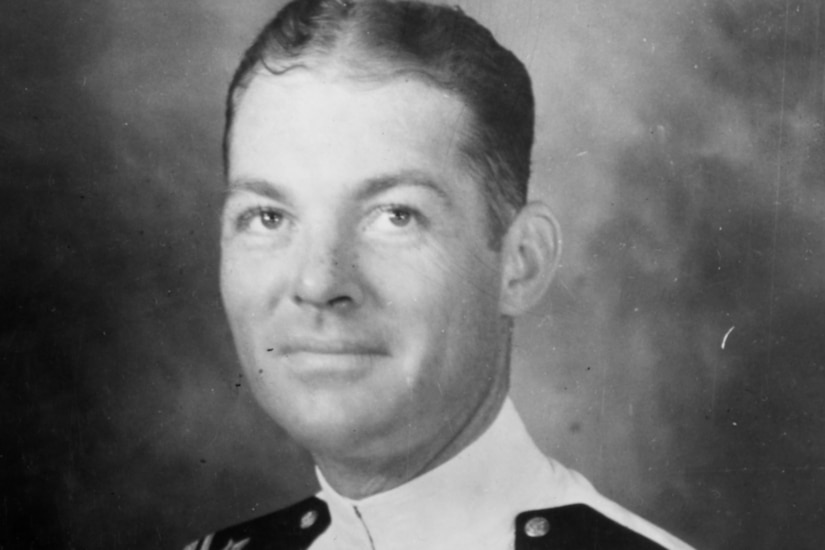
Navy Lt. Carlton Barmore Hutchins was a skilled aviator who did his best to save his crew during one of the worst naval air disasters before World War II. He kept his damaged plane in the air long enough for a few crewmates to parachute out. Hutchins went down with his aircraft, but his bravery and selflessness earned him the Medal of Honor.
Hutchins was born Sept. 12, 1904, to Walter and Clara Hutchins. He had two younger brothers and grew up in Albany, New York, before graduating high school in 1922 and attending the U.S. Naval Academy.
After commissioning into the Navy in 1926, Hutchins served on the USS Pennsylvania until 1928, when he went to flight training school in Pensacola, Florida. That same year, he married his girlfriend, Elizabeth Poehler. The couple later had a son, Walter.
By February 1929, Hutchins had earned his wings as a naval aviator. He spent the next few years flying fighter aircraft and scouting planes before studying aeronautical engineering at the California Institute of Technology. In 1937, he served with a seaplane squadron in the Caribbean before being transferred to Patrol Squadron 11 aboard the USS Langley based at Naval Air Station San Diego (now Naval Air Station North Island).
On Feb. 2, 1938, Hutchins was piloting one of several PBY-2 Catalina seaplanes that were taking part in one of the largest fleet exercises of the time about 70 miles off the California coast. According to the Naval History and Heritage Command, nine aircraft were flying in formation at night during a bombing training run when a sudden rain squall began and they flew into a cloud bank without warning. Because of the sudden lack of visibility, Hutchins' aircraft collided with another seaplane.
While the second aircraft crashed immediately, killing all seven on board, Hutchins managed to keep his failing aircraft in the air long enough to give his crewmates the chance to parachute to safety. He was only able to keep the aircraft afloat for a few minutes, but that was enough for four of the six men to jump out. The remaining two were in the plane's forward compartment with Hutchins and died with him as the plane went down.
One of the men who parachuted out died the following day, but three survived thanks to Hutchins' ability to keep calm and steady the aircraft for as long as possible.
The crash killed a total of 11 men. At the time, it was considered one of the worst aircraft disasters in Navy history.
On Aug. 3, 1938, Secretary of the Navy Claude Swanson announced that Hutchins would receive the Medal of Honor for his bravery. The nation's highest honor for valor was presented to his widow in a ceremony 10 days later.
Sadly, Hutchins' remains were never recovered.
In his memory, the destroyer USS Hutchins was commissioned in November 1942 and used throughout World War II.
At the Naval Academy's Bancroft Hall, one of the world's largest collegiate dormitories, Hutchins has a room dedicated to him, as do all other Medal of Honor recipients who attended the prestigious school.
This article is part of a weekly series called "Medal of Honor Monday," in which we highlight one of the more than 3,500 Medal of Honor recipients who have received the U.S. military's highest medal for valor.