
War Department, USDA Team Up on National Security
Arizona Free Press
← Back to
Economic News
By C. Todd Lopez
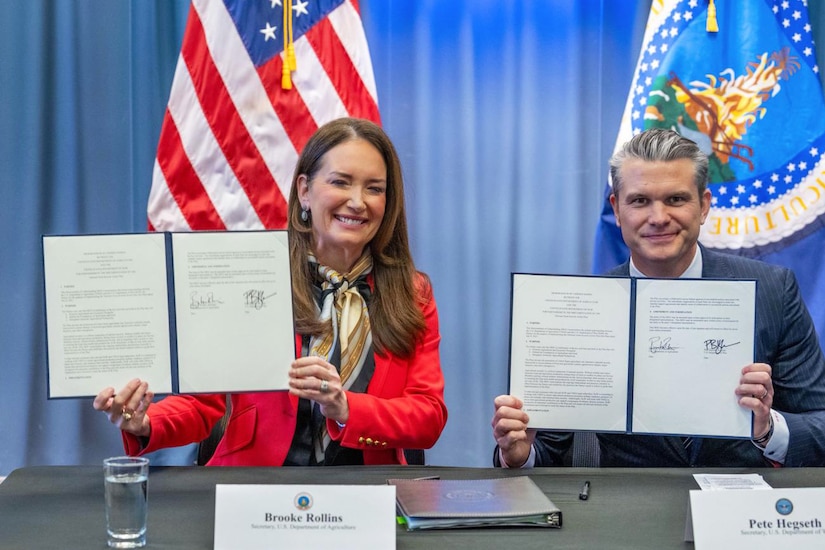
Secretary of War Pete Hegseth yesterday signed a memorandum of understanding with Agriculture Secretary Brooke Rollins, cementing the relationship between the two agencies under the National Farm Security Action Plan, and explaining how they will collaborate when agriculture and national defense intersect.
"We're going to promote agricultural and economic prosperity, defend the foundations of agriculture and food ... and strengthen domestic and agricultural productivity," Hegseth said. "Together, we are elevating the protection of U.S. agriculture into America's national security framework by ensuring systems remain protected against potential terror attacks, major disasters and other emergencies, with the full support of the Department of War and the national security enterprise."
In July 2025, the Agriculture Department announced the National Farm Security Action Plan, a government-wide, multi prong effort focused on ensuring America's ability to secure its own food supply, in part by eliminating interference from adversarial nations. Part of that plan involves using presidential authorities to reclaim farmland in the U.S. currently owned by foreign adversaries — such as China — including land owned by adversarial nations that encroaches on U.S. military installations.
"When our farmland is threatened, the welfare of the entire nation is put on the line," Rollins said. "It is undeniable that America's enemies are playing the long game, infiltrating our research institutions, stealing our technology, launching cyberattacks on our food system and buying up our farmland. China alone owns 265,000 acres of American agricultural land ... these actions expose strategic vulnerabilities in America's food and agriculture supply chain."
The National Farm Security Action Plan is designed to protect America's farmland, and DOW is part of that effort. The MOU solidifies the department's commitment to the plan.
"The National Farm Security Action Plan is a necessary step toward safeguarding our homeland against malign foreign influence," Hegseth said. "America is the best of ideas, but America is actually also a place; it is a land ... that we must defend at every single echelon, from space to the farm field."
One novel and immediate result of the MOU is that the USDA will have access to the Defense Advanced Research Projects Agency's capabilities.
"[DARPA] can do things, they can design things, they can bring things to life that no other agency across the federal government is remotely capable of," Hegseth said. "Working with [USDA], we will ensure agriculture projects directly enhance our military's strength and readiness."
While Hegseth and Rollins signed a cabinet-level MOU, another memorandum was signed yesterday between DARPA and USDA's chief scientist. According to a DARPA spokesperson, the memorandum between DARPA and USDA creates a direct path for collaboration on efforts with overlap in national, economic and agricultural security.
One example is the DARPA Guardian program, which is developing methods to mitigate the risks posed by non-native pests, including the New World Screwworm, a serious threat to the ranching community, the U.S. food supply and national security. The agreement signed yesterday further demonstrates a whole-of-government approach to tackling this critical problem.