
Army Tests APEX Counter-UAS Round in Arizona
Arizona Free Press
← Back to
Other Stories
By Ana Henderson, U.S. Army Yuma Proving Ground
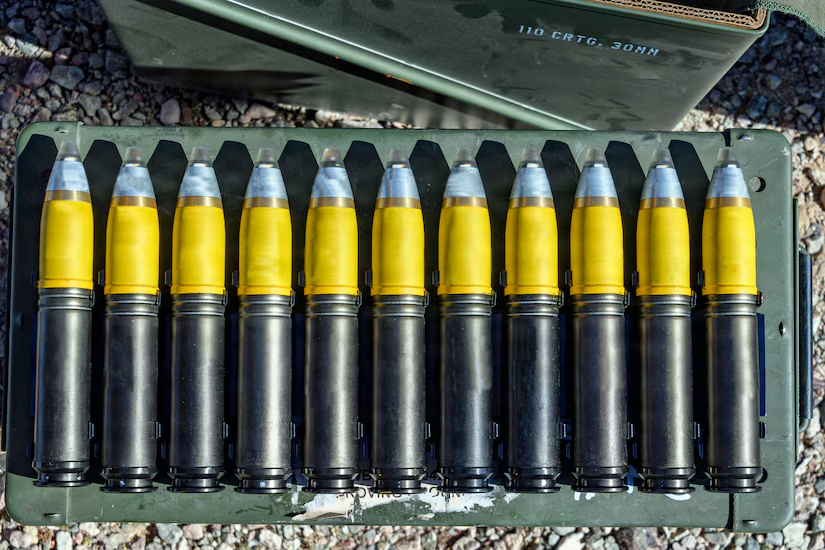
The Yuma Test Center at U.S. Army Yuma Proving Ground, Arizona, recently tested a new 30 mm Aviation Proximity Explosive round, primarily developed for firing from the AH-64 Apache helicopter.
The APEX closely resembles the fielded M788 training round and M789 high explosive dual-purpose round.
Walter McCormick, a test officer at the proving ground, explained that the APEX is designed to integrate with the existing M230 gun already mounted on the Apache.
"The APEX round was developed to be a [fragmented] round that would [explode] in front of the [unmanned aerial system] and make a [small] pattern that would take out a UAS," McCormick said, adding that the need for counter-UAS solutions is urgent.
In recent years, the UAS has become the weapon of choice on the battlefield, as seen in Ukraine and Russia. Army Secretary Daniel Driscoll is pushing for the Army to focus its efforts on UAS and counter-UAS technology. In fact, the Yuma Test Center has been designated as the primary, dedicated interagency counter-small UAS test and training range.
During testing, the center performed two subtests: the first to assess and compare it with the legacy M789 rounds, and the second test was to engage a UAS. Crews fired approximately 1,200 rounds across the two variants at both short and long ranges.
"We engaged a couple [of] different UASs and a few different ground targets," McCormick said.
Yuma Proving Ground has nearly 2,000 square miles of restricted airspace and year-round sunshine, which makes it ideal for aerial testing.
"They have done ground testing at other ranges. The problem is they don't have the land or airspace to do aerial firing from a helicopter. So, that's a big benefit. Plus, all the unique instrumentation YPG offers," McCormick said.
During the APEX test, the proving ground used its full arsenal of support capabilities to collect data, including air-to-ground assets such as chase pilots from UH-60 Black Hawk helicopters flying overhead for scoring, tracking mounts, telemetry, high-speed video, still photographers and data collectors.
These assets are readily available to industry partners testing at the proving ground.
"The Black Hawk was used primarily for overhead [scoring], so we can assess where rounds are impacting based on [the] firing point of the aircraft. The other benefit of surrounding ground camera angles was having a 360-[degree] view of the situation," McCormick said.
The next step for the APEX is to undergo airworthiness release based on the current test results. This will provide a safety release for the APEX to be fired from Apaches by soldiers when rounds are available. The airworthiness release is a milestone on the road toward materiel release and fielding.