
Endangered black-footed ferrets released in northern Arizona
Arizona Free Press
← Back to
Other Stories
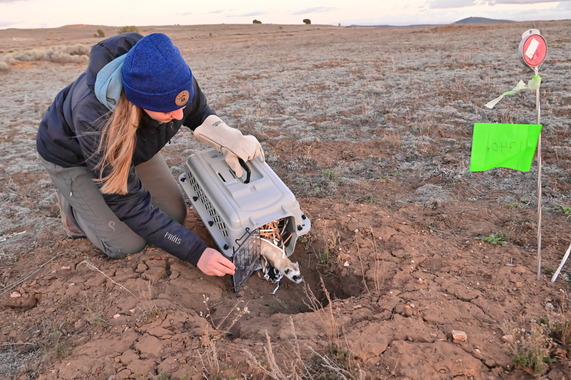
AZGFD is working alongside partner organizations to recover the imperiled species
Arizona Game and Fish Department personnel released 19 endangered black-footed ferrets at three sites in northern Arizona, bolstering the wild population of one of America’s most imperiled mammal species.
On the evening of March 10, department biologists and wildlife managers released 13 ferrets into the Aubrey Valley and Double O Ranch near Seligman, Ariz. and six ferrets at Garland Prairie near Parks, Ariz.
Numerous partner agencies and private landowners attended the releases, including the U.S. Fish and Wildlife Service, the U.S. Forest Service, the Arizona State Land Department, Habitat Harmony, the Phoenix Zoo and the Navajo Nation. Recently confirmed Game and Fish Commissioner Jessica Manuell also attended the release.
The endangered ferrets originated from captive breeding programs at the Toronto Zoo and the Smithsonian National Zoo, before being transported to the Black-footed Ferret Conservation Center in Colorado run by the U.S. Fish and Wildlife Service.
At the Conservation Center, the ferrets learned to hunt and survive in the wild before making their final journey to Arizona.
There are 35 ferret release sites located across the United States, and only two are located on land managed by the U.S. Forest Service. One of those is Garland Prairie, which saw its first ferret release in 2025.
“We had many partner agencies show up to support this project. These releases couldn’t happen if we were working by ourselves. We require a lot of help from partner organizations to make it happen.” said Holly Hicks, small mammals program coordinator for the Arizona Game and Fish Department.
“Adding natural predators, like black footed ferrets, back into the system is part of the natural order of the landscape. It's important work to be a part of that.” said Hicks.
The Black-footed ferret is North America’s only native ferret species, characterized by the distinct black markings on their feet, tails and faces.
Once abundant across western North America, ferret populations plummeted in the 20th century due to habitat loss and disease. The species was thought to be extinct until the early 1980s, when a small population was discovered in rural Wyoming.
By 1986, only 18 ferrets remained in this isolated population. Then, wildlife managers took an extraordinary step to recover the species– capturing all of the surviving individuals and creating a captive breeding and reintroduction program.
Today, there are approximately 300 black-footed ferrets living in the wild in the United States. After the latest release, Arizona is home to about 20 wild ferrets.
The biggest threat to black-footed ferret recovery is sylvatic plague, a bacterial disease carried by fleas that infects both the ferrets and their main prey, Gunnison’s prairie dogs.
While the released ferrets are vaccinated against the plague, their offspring will be vulnerable to the disease.
After thoroughly surveying multiple prairie dog colonies, department biologists saw little to no signs of plague at the release sites, giving the ferrets the best chance for survival.
"We are anticipating that a spring release will give the ferrets a greater chance at survival since prairie dogs are beginning to emerge and it will be easier for the ferrets to find prey. It is also at the beginning of the breeding season for ferrets so we are hoping that we will find wild born litters this summer,” said Jennifer Cordova, black-footed ferret project field coordinator for the Arizona Game and Fish Department.
The ferrets and their offspring will be closely monitored by biologists through ongoing spotlighting and trapping efforts.