
Digital Billboards Help FBI Capture Fugitives Nationwide
Arizona Free Press
← Back to
Other Stories
Public-private partnership aids investigations for nearly two decades
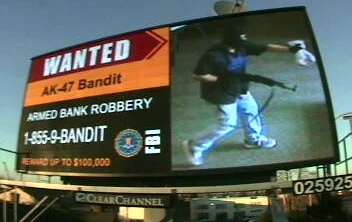
For nearly two decades, digital billboards across the country have done more than advertise products—they’ve helped bring fugitives to justice, displaying faces and names that have led to arrests in more than 55 cases.
The effort is part of the FBI’s digital billboard program, a nationwide initiative that uses outdoor advertising networks to share information about wanted fugitives and urgent public safety messages with millions of people each day.
That reach and impact traces back to a modest beginning.
In October 2007, during a session of the FBI’s Citizens’ Academy in Philadelphia, a Clear Channel Outdoor executive sat among a group of civilians learning how the Bureau works. The program is designed to demystify federal law enforcement, but in this case, it also sparked an idea: What if the FBI could use digital billboards—then still an emerging technology—to publicize fugitives?
Clear Channel Outdoor offered access to its digital billboards in the Philadelphia market. The FBI accepted. Soon, wanted posters of a different kind—digital, dynamic, and highly visible—began appearing above highways and city streets.
The results were immediate. Tips flowed in, and within a short period, two fugitives were apprehended as a direct result of the billboard publicity.
Encouraged by that success, FBI Philadelphia and the company began exploring whether the concept could extend beyond a single city. Their vision was both practical and ambitious: a nationwide network of digital billboards that could be activated quickly to assist in locating fugitives and delivering urgent public safety messages.
On December 24, 2007, that vision was formalized into a national partnership.
Today, about 10,000 digital billboards operate across 46 states, forming a far-reaching network that engages millions of people each day. The screens—most often used for commercial advertising—have, at critical moments, been repurposed to carry FBI messages. After the 2017 mass shooting in Las Vegas, for example, the FBI posted a Seeking Information message on billboards that generated more than 4,000 tips from the public.
“The digital billboard initiative puts critical public safety information in the right place at the right time,” said Ben Williamson, assistant director of the FBI’s Office of Public Affairs. “Over the years, tips received because of billboards have helped the FBI capture violent criminals, solve complex crimes, and educate the public about threats to the community. It has been one of the FBI’s most successful private partnerships, and we are grateful to the media owners who donate valuable digital space to help us keep Americans safe.”
The program’s reach has expanded well beyond its original partner. Multiple digital billboard companies now participate, offering their space as a public service. There is no cost to the FBI associated with the initiative. Instead, the messages run as space becomes available within each company’s pre-sold advertising rotation—appearing briefly but often enough to leave an impression.
Over time, those brief appearances have added up. More than 55 fugitives from cities across the country have been apprehended as a direct result of tips generated by the billboards.
In 2017, a fugitive featured on billboards in the Tampa, Florida, area saw his own image and turned himself in. In 2019, a bank robber linked to crimes in six states—the so-called Traveling Bandit—was arrested in Colorado after a tipster recognized him from a billboard. New additions to the FBI’s Ten Most Wanted Fugitives list are also frequently featured on the displays, which include placements in bus shelters.
Recently, the FBI renewed its memorandum of understanding with the Out of Home Advertising Association of America Inc., reinforcing a partnership that now spans much of the outdoor advertising industry.
For the FBI, the program has become a steady and effective complement to investigative work. For the companies involved, it represents a civic use of commercial infrastructure. And for the public, it offers a simple but powerful role: an opportunity to help.