
How S&T is Helping the Coast Guard Prepare for a Black Swan Event
Arizona Free Press
← Back to
Other Stories
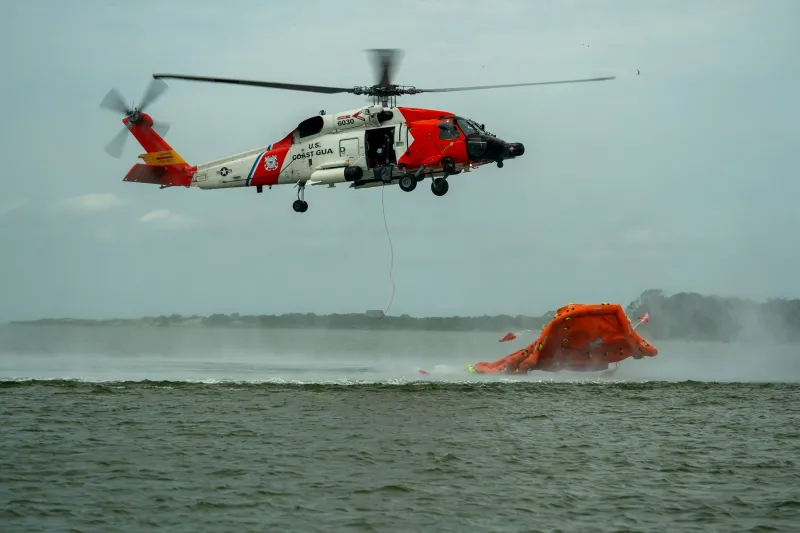
The Science and Technology Directorate (S&T) has been collaborating with the U.S. Coast Guard (USCG) and industry partners to develop a viable search and rescue solution that could deploy during large-scale disasters on the high seas. Here is an exclusive look behind the scenes at the August 2025 open-water test of a new mass rescue technology at USCG Station Oregon Inlet in Nags Heads, North Carolina.
When things go wrong out on the open ocean, the situation can get pretty bad, pretty quickly. Thankfully for all of us, the USCG is there to respond.
“The U.S. Coast Guard has an important mission. They perform rapid search, rescue, and response,” said Travis Brown, S&T Program Manager for the Maritime Safety and Security Program. “Sometimes these missions are performed in environments that are not easily accessible, like far from shore. That can make them even more complicated, and that’s why S&T brought together USCG and our private industry partner, VIKING Life-Saving Equipment A/S, to test VIKING’s mass rescue floatation device.”
As a joint effort between S&T, the USCG Research and Development Center, and the USCG Office of Search and Rescue, the device was tested in a real-world simulation to assess performance and success metrics, as well as to inform future testing and evaluation. The trials included loading the device onto an aircraft, transporting it to the drop site, deploying it over open water, assessing its ability to properly inflate after the drop, gauging multiple swimmers’ ability to board the device from the water, as well as it’s stability once the swimmers had boarded it.
Some Mass Rescue Operations Require a Unique Solution
A mass rescue operation (MRO) at sea is a large-scale search and rescue (SAR) effort. It is initiated when an incident occurs offshore and the number of people in immediate danger is so great that a standard response would be inadequate.
What makes this rugged device interesting is that it has a 100-person capacity but is still compact and easily transportable. A solution like this could potentially increase the speed of rescue response because one day they could be carried on USCG vessels, air assets, or even non-USCG boats and ships. That’s important, because in an MRO, getting people out of the water as quickly as possible is essential. Time saved can mean lives saved.
The majority of USCG SAR cases happen within about 20 miles from shore. Within that mission range, they can either deploy their own USCG assets, or if needed, they can call in state and local partners to assist. Outside 20 miles, a capability gap arises due to the time it takes to get on scene—and the gap grows the farther an incident is from shore.
S&T’s ultimate goal with this research, development, testing, and evaluation effort is to close that gap by creating a capability for rescuing large numbers of people from an event that happens to be 25, 50, or even 100’s of miles out to sea.
Airliners, passenger ships, and even deep-sea drilling platforms, all have multiple safety features and life-preserving equipment. However, there are scenarios where some or most of these existing devices could be insufficient or become otherwise compromised to the point of ineffectiveness. That could leave a lot of people in grave danger. The farther offshore an event like this happens, the greater the risk for the loss of life.
Black Swans are a Different Breed
As the premiere maritime SAR organization in the world, USCG has to be prepared for everything. That includes being prepared for the unexpected, because the unexpected does happen.
MRO events (especially ones at sea) are considered “Black Swan” events because they are rare and by nature, low probability. However, they are also high consequence events. That means that if one does occur, the results could be catastrophic.
The complex challenge that the USCG would face with an offshore Black Swan MRO would be how to quickly deliver life-saving equipment to large numbers of people who are in the water well outside the standard rescue perimeter.
Currently, most of the large rescue rafts in the USCG inventory can only hold about 30-40 people and the devices are so large and bulky that they can only be deployed by a ship. When the clock is ticking and the distance is great, surface vessels just are not fast enough. Helicopters are much faster, but they can only pluck and carry a limited number of victims from the water at a time. To help close the gap, USCG needed a solution that was built for rapid deployment, but also large enough to accommodate significant numbers of survivors.
It wasn’t easy finding the right company, design, or even construction materials needed, but the solution came after S&T’s Small Business Innovation Research Program put out a request to industry. Eventually, S&T identified a vendor and a product that seemed capable of satisfying the stringent USCG mission requirements.
The Next Step was to Test the Device in the Open Water
Previous testing of the device was done in a large indoor pool, but this would be the first time that USCG would deploy the device from a helicopter into open water.
The device is somewhat like a deflated rubber raft squeezed inside a hard-shelled canister. It weighs about a 100 pounds, was carried in a large duffle-like bag, and loaded onto an aircraft.
One of the testing objectives was to make sure that the flight mechanics on the USCG MH-60T helicopter could properly secure, transport, and deploy the device safely.
After flying out more than 100 yards from the inlet shoreline, the helicopter hovered above the water. Then, the USCG rescue swimmers jumped in to take their positions.
Once the rescue swimmers gave the “thumbs up,” the support vessels navigated into position and the helicopter moved to the drop point. Then, it was time for the flight mechanics onboard the MH-60T to carefully release the device into the water.
As the device was being deployed from the side door of the MH-60T, a lanyard was pulled. That action triggered a mechanism that began inflating the chambers within the flotation device with compressed air from a series of canisters.
As it fell to the water below, and amidst the rotor wash from the helicopter above, the device began to inflate.
Within a matter of seconds, it was fully inflated and took on a shape resembling two off-set pentagons stacked on top of each other.
This star-like design feature, along with strategically positioned tethered weights that act to keep the device steady and in contact with the water, help to make it a stable platform. Even when exposed to the powerful rotor wash from the helicopter, the device remained flat on the surface of the water, like a floating carpet.
When the inflation was complete, the rescue swimmers approached the device. Following the directional arrows on the sides, they quickly boarded it using the well-positioned and easy-to-grip boarding straps.
The boarding proved to be speedy, simple, and intuitive—and that was by design.
There are so many potential failure points in an exercise like this where something can malfunction or go wrong. In this case, the device performed as planned in real-world conditions.
“I think the key takeaway from today, is this is an example of how S&T can bring industry, federal partners, and the DHS component together to deliver an innovative solution to help the end user achieve success in its mission—in this case, we are helping the USCG close a capability gap in extremely complex rescue operations,” said Brown.